

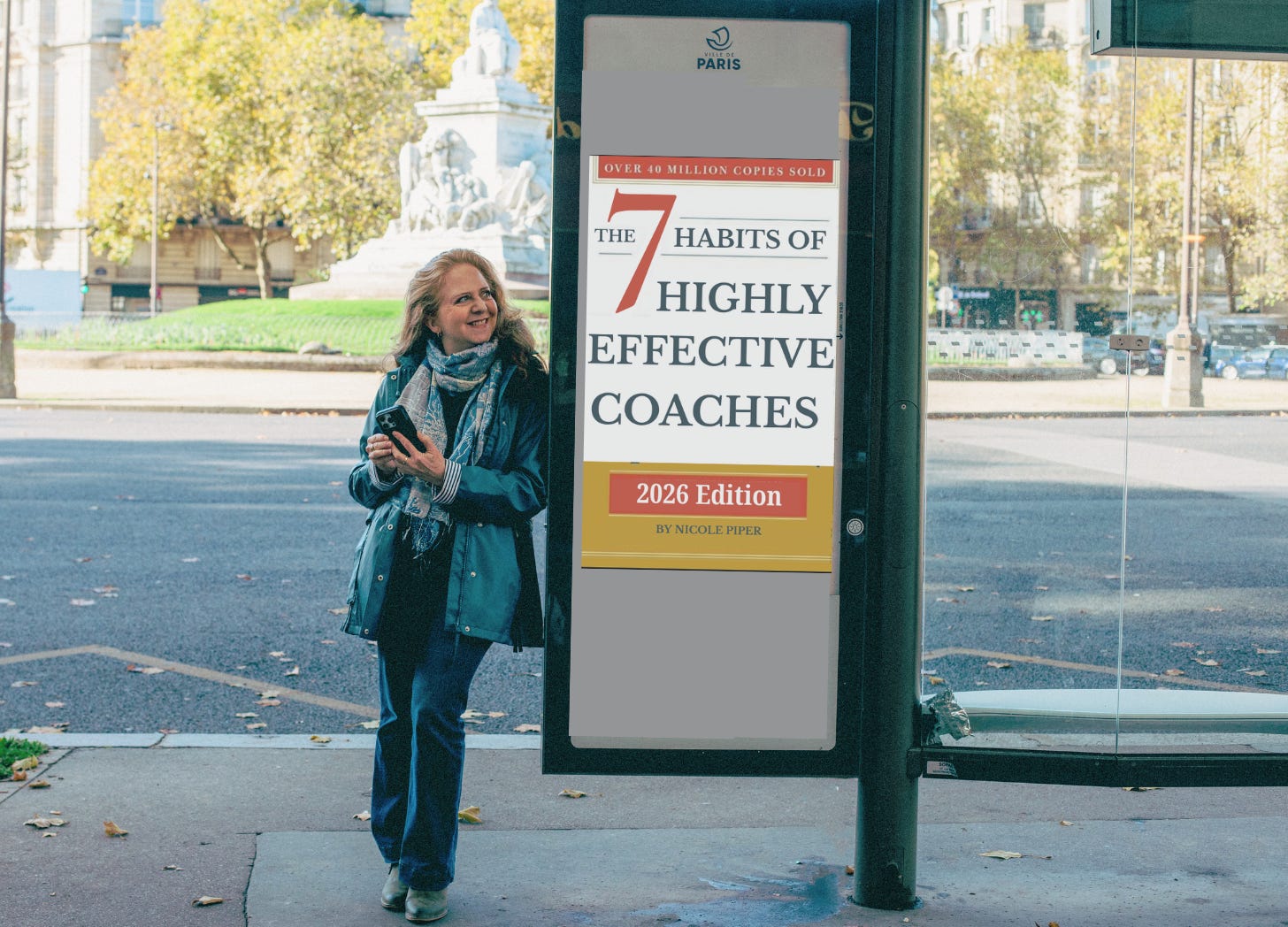
The rules have changed.
If you’re a health or wellness expert building an online coaching business in 2026, the tactics that worked even a year ago are falling flat. And if you don’t adapt, you’ll join the 90-95% who don’t make it.
At the heart of this is intense market skepticism.
Of course, the market has always been skeptical, but it’s only gotten worse. AI-generated content has flooded every platform. And potential clients have been burned by too many promises that didn’t deliver.
That’s why I’m sharing these seven things that can help you move your business forward in 2026. But first, let me be clear about something.
There’s no shortage of “gurus” telling you what tactics to use. And here’s the problem:
Tactics without principles is a recipe for wasting time and money.
These seven habits are the foundation I now use with every client. They’re based on my 29 years building Fortune 500 brands and my work with over 1,000 health and wellness professionals since 2018.
If you use them, you’ll be a step (or seven!) ahead of most people.
Let’s dive in.
Habit #1: Focus on Building Trust
This is the foundation for everything else. And in 2026, trust is harder to build than ever.
Last year, I talked about building relationships as Habit #7. Trust is obviously part of that. But trust has been eroding so much recently that it’s now at the top of the list.
Because without trust, nothing else works. Not your offer, your marketing, your webinar… nothing.
It used to be that we could smell inauthenticity a mile away. But now it’s even harder. (I think of that every time I send my son a cool IG video, only to have him point out it was made with AI.)
So here’s what I’m recommending my clients and partners do to build trust in this day and age:
Create a clear trust-building pathway
Don’t just post random content on social media hoping something sticks. Have an intentional strategy for how you’ll build trust with potential clients. That way, when you give them something to invest in, you’ve already established trust ahead of time.
Some of the ways of doing this are to deliver consistent value without always asking for something in return. Also, show up authentically, flaws and all. (Not polished perfection — my YouTube videos are a perfect example of this!) And be transparent about your process, your results, and yes, even your failures and what you learned from them.
Another great way to build trust is to anticipate people’s objections and resistance, and address them head-on. And make sure you have some proof your approach works in the form of testimonials, genuine case studies, and your own story.
Understand buying speed
Most people need multiple touch points before they’ll be ready to invest with you. So create enough opportunities for people to get to know you, learn from you, and trust you. (More about this in Habit #4.)
Build relationships through email, not just social media
Email is the only platform you truly own. That means those pesky algorithm changes can’t take it away from you. And email gives you space for deeper, more meaningful conversations with your audience.
The bottom line: In 2026, trust is the currency that matters most. If people don’t trust you, they won’t buy from you, no matter how good your offer is.
Habit #2: Validate Before You Build
This is a critical shift for 2026. And it will save you from wasting your valuable time and money.
Too many coaches build first, then use their launch to validate their offer. They spend months creating a program and invest time and money trying to market it through painful social media posting or expensive ads.
But no one buys.
That’s a real possibility for people who don’t validated if there’s actual demand for what they created.
When you do the deep research I’m about to describe, you can validate your idea with up to 95% certainty that people will buy.
Here’s my validation process:
First, I look at YouTube demand. I dig into what people are actively searching for and what problems they’re trying to solve.
Second, I analyze Amazon book reviews. I’m looking at what customers love, what they complain is missing, and what questions they still have after reading the books.
For example, when I was researching for a client in the Hashimoto’s space, I found reviewers kept saying “I wish this book covered more about X.” That told us exactly what gap to fill.
Third, I spend time in Reddit communities. I want to see what language people use, what they’ve tried that didn’t work, and what they’re desperately looking for.
Fourth, I examine SEO data and search trends across the entire internet. What are people typing into Google? How many searches per month? Is demand growing or declining?
Then I run this data through my 7-Point Green Light Framework. This evaluates: problem urgency, market size, client affordability, your credibility, proven demand, competitive differentiation, and your path to reach ideal clients.
If your offer passes all seven criteria, you get a green light. If not, you know exactly what needs to change (or whether to pivot entirely).
By the time you’re done with this process, you’re not guessing. You’re building on solid ground with real data backing you up. (At the end of this article, I give you a way to fast-track this process because it can take a long time.)
Habit #3: Build AI-Proof Marketing
One of the biggest problems I saw in 2025 was assembly-line marketing. The result was people were given templates and generic funnels created by AI that made everyone sound the same.
And the problem has only gotten worse. Now marketers see AI as a way to pump more people through their programs and boost their profits. That means your potential clients are being bombarded with even more assembly-line marketing funnels.
Some of my clients who fell into that trap told me shocking stories. I heard quite a few times from experts about being on calls with potential clients who called them out. They said they’d already watched several other webinars that looked almost identical. Some even used the same stock images!
This kind of assembly-line marketing makes you invisible. And it kills trust before you even have a chance to build it.
Not only that, potential clients could post comments on your ads or social media and spread the word that you’re not saying anything new. (Talk about a trust-killer!)
Now I want to be clear about something. AI is a fantastic tool. I use it almost every day. I use it for research, like what I described in Habit #2. I also use it for brainstorming and rough copy ideas. And it can be a fairly good junior copywriter.
But I’m a professional copywriter with elite training. So I can tell the difference between good copy and junk. And the best AI can do is give me some ideas as a starting point. Then I have to develop them (usually quite extensively).
For people without solid copywriting skills, AI can give them a false sense of security. I can’t tell you how many times people show up on my weekly coaching calls with copy written by AI. They feel good about it because “AI wrote it.”
But it needs a major rewrite.
Most of the time, I don’t even have to read a word of the copy. I can tell just by looking at it that it was generated by AI because the writing is so predictable.
Many gurus try to fix the problem by hiring junior copywriters to edit the AI generated copy. That might improve it a bit. But it’s the idea behind the copy that’s much more important. (We’ll talk about that more in Habit #6.)
The best approach, if you really want to make sure you stand out and stack the marketing odds in your favor, is to hire a skilled professional who will help you craft unique positioning. Barring that, here are a few things you can do:
How to build AI-proof marketing:
Use AI as a tool, not a replacement. Use it for research, to brainstorm ideas, and to create rough drafts. But then rework it completely so it sounds like you.
Do your best to avoid templates and cookie-cutter funnels unless you feel confident in your ability to edit and improve them. Ultimately, you want to make sure your marketing sounds like YOU.
Habit #4: Leverage Different Buying Speeds
Leveraging different buying speeds is another key shift for 2026. And it’s a natural consequence of the 3 habits we just covered.
Here’s what you need to know…
Ultimately, the purpose of a marketing funnel is to help you get more clients. A lot of people try to use a short funnel that gets people to take an action quickly, like booking a call with them. And they end up frustrated when only a tiny percentage of people book.
The reason why this happens is that most people are not fast buyers. So if you have a short funnel, you need to be prepared for that.
Generally speaking, about 50% of people who encounter you will be non-buyers. They’re not your ideal clients, and you can forget about them.
Of the remaining 50%, only a tiny percentage are fast buyers (about 3-5%, at best). These are the ones who watch your webinar and immediately book a call.
But the vast majority are slower buyers. They want to get to know you better, first.
And these days, buying speed has slowed even more. People have a lot more choices. Plus, as I mentioned before, they’re ultra skeptical because they’ve been burned before. Add economic uncertainty to the mix and they’re even more cautious about spending.
So here’s what you need to do:
Understand that most people won’t buy right away, so you don’t get discouraged when only a few book calls with you immediately. That’s normal.
You can prepare for this by creating multiple buying opportunities, instead of having just have one offer at one price point. (We’ll cover this in more detail in the next habit.)
Finally, prioritize your email marketing. Stay in front of them. Continue delivering value. Give them more opportunities to see your expertise and build confidence in you.
Habit #5: Have a Strategic Offer Sequence
This is essential for 2026, and it’s a natural follow-on to leveraging buying speed.
If people need more touch points before they’re ready for your high-ticket program, you need to know what to offer them in the meantime.
That’s where a strategic offer sequence comes in.
A strategic offer sequence is a series of offers at different price points. They work together to:
Build your email list
Establish your expertise
Educate prospects on your unique approach
Create natural desire for deeper work with you
Help you generate income faster
Pre-sell your high-ticket program
Each step builds trust and commitment.
Here’s what I recommend:
Start with a low-ticket offer (under $100) that builds your list, educates people on your approach, and proves your expertise.
Then have a mid-ticket offer ($500-$1,500) that delivers quick wins, deepens trust, and creates desire for more.
Finally, create a high-ticket program ($2,000+) to give people a premium experience. For example, give them more support and direct access to you.
Each offer naturally sets the stage for the next.
What I love about this approach is that it gives you the chance to test different offers and messaging with your low-ticket offer. You can quickly figure out what resonates most with your market before investing time and energy in creating other offers.
Now, I want to acknowledge there’s another path, which is the high-ticket offer funnel. With this funnel, you typically run ads to a webinar or masterclass. The intent is to have people book a call with you, where you sell them your $2,000+ program.
I’ve seen this approach work very well, but only in certain circumstances. For instance, if you have a proven offer, financial runway, at least $5,000-$7,000 to invest in ads while optimizing, sales skills to close on calls, and time and patience. (It can easily take 6-12 months to dial in your funnel.)
I’ve worked with many health professionals who followed this approach and got clients in the first month. But I’ve also worked with many where it took 12 months (and thousands in ads). So I want to be up front about that.
Most health professionals starting out online don’t have all these pieces in place, even if they’ve had a brick & mortar practice for years. That’s why the strategic offer sequence is usually the better path, especially in 2026 with slower buying speeds and economic uncertainty.
Habit #6: Become a Category of One
Becoming a Category of One means finding a way where you’re not competing head-to-head with other coaches. You’re in your own category.
I know it’s not easy to do, but it can make a tremendous difference to your business in multiple ways.
First, it makes you sound different from everyone else. So you stop blending in with other coaches.
Second, this obviously helps you get more clients because people notice you. They see you’re different.
Third, when you know what makes you different, and you can articulate it clearly, it gives your confidence a real boost. The end result is many people end up charging more for their services.
Here’s my three-part Category of One formula:
First, fill the gaps. When you do deep market research (from Habit #2), you discover where people are dissatisfied with other options. What are other coaches missing? These gaps are your opportunities.
Second, create relevant uniqueness. This is about positioning your OFFER, not your personal brand. You need to show people you have a unique approach to solving their problem. This makes you unique in a way that’s relevant to your audience and the problem they have.
One of the best ways to do this is by helping people see their problem in a new light (which also establishes your thought leadership position). You can also address their resistance head-on and create a Signature System that shows your unique approach.
Third, share your story. Most coaches are told to focus on this first as part of developing their brand. But people with health problems don’t initially care about your brand.
Your story only matters AFTER you’ve shown them you have an offer that fills a gap and a unique approach.
Your story should help people see why you’re qualified to help them. You can share your personal experience with the problem or helping people with it, as well as your lifestyle and values. Just make sure they’re relevant to your ideal client.
One of the things about my personal story that makes me different is that I’m not a former health coach, like so many people giving marketing advice. Instead, my entire career has focused on marketing, including my 29-year background turning entertainment properties into high-profile brands.
My personal story also includes my advanced copywriting training and my passion for building a business that allows me to travel 2-3 months a year.
These things help my ideal clients see why I’m uniquely qualified to help them and what kind of business I can help them build — one that gives them freedom and supports the lifestyle they want to live.
Habit #7: Build for Sustainability, Not Quick Wins
This final habit might be the most important because it ties everything together.
The first six habits are tactical. They’re the “what.” But this final habit is about the mindset that determines whether you’ll actually succeed or quit before seeing results.
The sad fact is, most people give up too soon… often because they’re not following these principles.
They launch their offer. Run ads for a few months. Don’t see results. And quit.
I’ve seen coaches give up after 4-5 months of not seeing a return on their investment. They’re afraid they’re throwing good money after bad. (Revisit Habit #2 to help avoid that fate.)
Let me tell you about a health coach who helped high school hockey players improve their performance. It was a challenging market because she needed both the teen and parents on board.
It took 12 months before she really gained traction. But now she’s hitting consistent $20,000 months.
If she had quit at month 5 or 6 like many do, she never would have seen that success.
(And to be very candid, I suspect she would have gotten there much faster if she had followed a validation process earlier in the game.)
Here’s what building for sustainability involves:
Commit to the long game. Understand that building a profitable coaching business takes time. It’s not a get-rich-quick scheme.
Invest in optimization, not just creation. Don’t just launch and hope. Validate your idea first. Track metrics. Test different approaches. And make data-driven decisions.
Give yourself a financial runway. Don’t put yourself in a position where you HAVE to see results in 30 days or you can’t pay your mortgage or rent. Give yourself space to test and optimize without panicking.
Persist through the “messy middle.” That’s the phase where you’re working hard, spending money on ads, not seeing results yet, and questioning everything.
Many quit in the messy middle. The ones who succeed push through. And you can get through the messy middle much faster when you’ve validated your offer, first.
Your Next Move
When you combine all seven habits, you’re not just building a coaching business… you’re building a sustainable, profitable business that can weather almost any market changes.
These aren’t just theories. This is the exact framework I use with my clients. And it works. One of my clients increased her enrollments by 41% once we did some of the work I told you about here.
If you want deeper strategies on each of these habits, I cover them extensively in this newsletter. There are already dozens of articles giving you specific marketing insights to build a profitable coaching business.
Since you’re still reading, I’m guessing you liked this post. If that’s the case, it would mean a lot to me if you gave it a like. And if you have a moment, let me know in the comments which of the habits was a new idea for you.
That’s all for this week!
Be well…
Nicole
P.S. I talked a lot about market validation in this article because it makes such a difference. That’s why it’s the first thing I do when considering working with someone. It’s so important that I’m now offering it as a stand-alone service. If you’re interested, click this link to find out more.