


If I wanted to build a six-figure online health or wellness business in 2026, there are a few things I’d do differently than I would have done just a year ago. Because as you’ve probably noticed, times have definitely changed!
In this article, I’m going to share the 3 things I’d focus on this year.
The good news is that doing these things will help you whether you’re just starting out, or if you want to get your current marketing performing better.
Here’s exactly what I’d do:
1. I’d make sure there’s proven demand for my offer
Many health and wellness professionals focus on what they think people want to buy or they hope people will buy. Instead, you should look at real data to find out what people are actively searching for, asking for help with, and already paying for.
This comes down to answering two specific questions:
First, is there real demand? Is there actual search volume, book sales, and people on active communities asking for help?
Second, how much are people paying for help? Are they willing to pay premium prices? Are there successful coaches already charging $2,000 to $5,000 or more for their programs? Or is this a race-to-the-bottom idea?
Some of this may seem counter-intuitive. I know a lot of people are afraid of working in a market that seems “crowded.”
But that’s really the best indicator of proven demand. So competition is a good thing! (If you’re concerned about how to best deal with competition, stick with me. We’re covering that next.)
How to get the answers you need
This is where you need to invest time in deep research.
When I do this work for my clients, I look for activity on YouTube, Amazon book reviews, Reddit communities, and Google search trends. I look at relevant content. I pay attention to what people are actually talking about.
That’s where the gold is!
Look for things like what they love about the books and videos they’re finding. What do they complain is missing? What solutions have they tried that didn’t work?
This qualitative data is just as important as the quantitative data.
Then I’d analyze competitors and what they’re offering. I’d compare their programs and price points. This tells me the market is both real and profitable.
When you focus on an offer with proven demand, you eliminate the biggest risk in starting a coaching business. And that’s spending time building something no one wants and money trying to market it.
When you do the research ahead of time, you’re not hoping or guessing. You’re building on solid ground.
2. I’d develop unique positioning that shows people why I’m the obvious choice
Back when I was just starting out as a copywriter, a SaaS company hired me to create their website. Their product was software that could manage all your social media marketing for you. It would help you create the content and then you’d set up a posting schedule on all the social platforms you wanted to be on.
The first thing I did was research the market. I got a list of 22 competitors and analyzed them all. I put together a detailed spreadsheet that laid out all of their market positioning, their website headlines, and all the details of their offer.
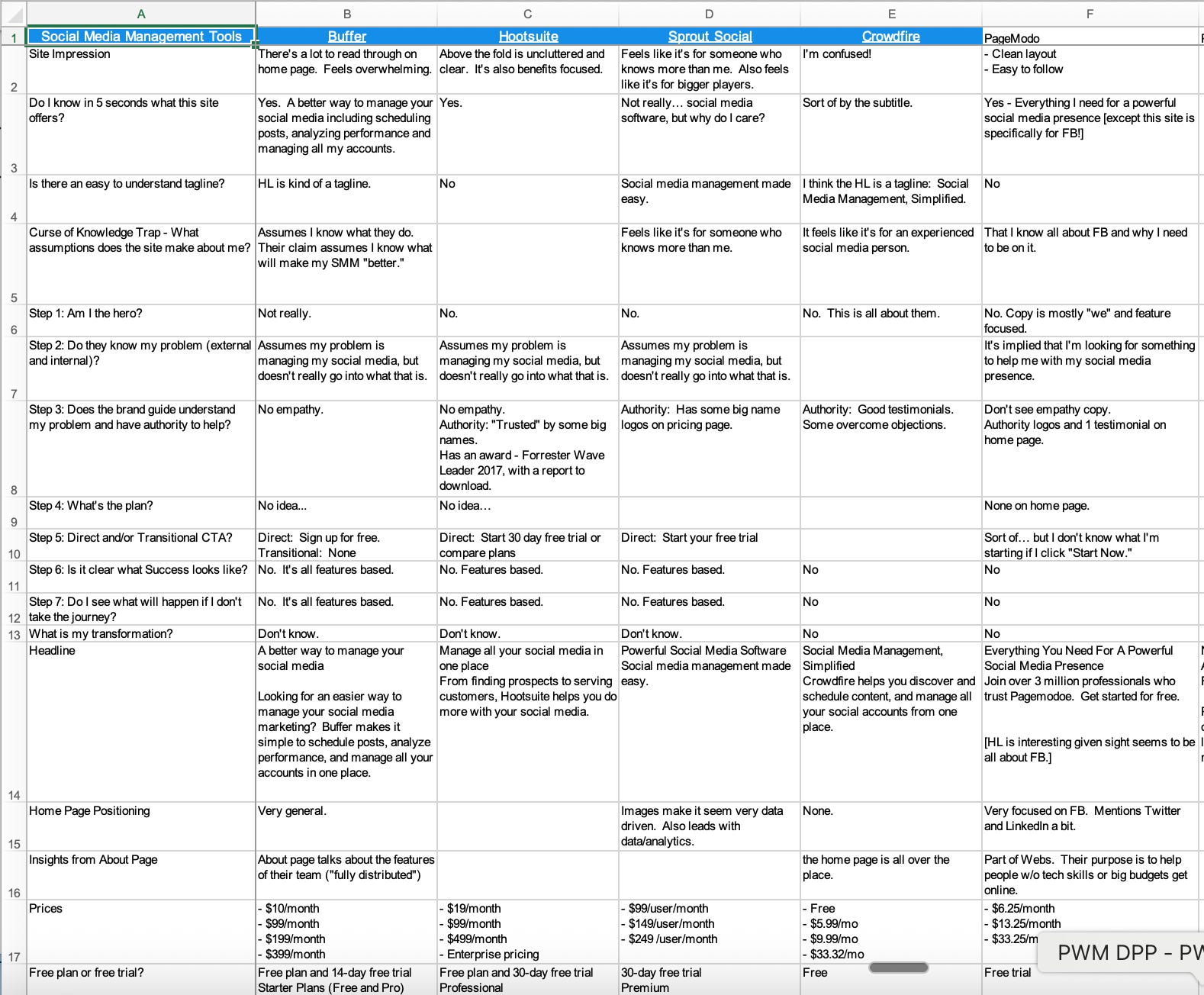
Twenty-one of them said some kind of version of “all your social media marketing in one place.” And two of the company’s headlines were exactly that — Now You Can Manage All Your Social Media Marketing In One Place.
Only 1 of the companies had unique positioning. They focused their platform on a very specific target audience.
When I presented my research to the company president, I showed him why it was so important for us to have unique positioning.
But he pushed back. He said it would limit their market potential. And he was adamant about going with the ‘all your social media marketing in one place’ angle, even though I strongly advised against it.
A few years later I wanted to check in on them — but the company was no longer in business.
This is why having unique positioning is so important. It’s the best way to give yourself a fighting chance.
When you look at the health and wellness market, so many experts sound exactly the same. I can’t tell you how many times I’ve heard coaches say things like, “I help women in peri-menopause lose weight.” Or, “I help busy moms get healthy.” Or, “I’m a health coach for executives with burnout.”
Some people will tell you the answer is to niche down further. And yes, being specific can help. But that alone is an entry-level approach.
What you really need is a way to be in a Category of One.
That means you need to do the work to find gaps in your niche. You want to find the specific things people want that aren’t being addressed. That means looking at what your competition is talking about and what they’re missing.
For example, I was doing research for a health coach who focuses on thyroid issues. I found a few specific gaps in the market that people were desperate to get help with.
Those gaps are golden opportunities.
Whatever problem you focus on, there are gaps and underserved areas of the market. If you create an offer that focuses on addressing those gaps, you have a much better chance of standing out.
That’s the first part of positioning, but you can’t stop there. You need an additional layer of differentiation. This is what I call your “pixie dust.”
Turning plain old positioning into pixie dust positioning does take deep thinking, which is probably the reason why I haven’t seen a single business building program show health and wellness professionals how to do it.
It’s a bigger topic than what I can cover in this article, but if you’d like some guidance, I talk more about it in this one: “If You Feel Lost In The Saturated Health Coaching Market… here’s how to stand out and be unforgettable”
Okay, let’s move on to the third thing I’d do. This is something I developed after watching countless health and wellness professionals spend tens of thousands of dollars trying to launch high-ticket funnels that flopped.
3. I’d create a strategic offer sequence that turns unique positioning into revenue
A strategic offer sequence is a marketing approach that feels more authentic than a lot of the other approaches health and wellness professionals are given.
Instead of using marketing tactics that can feel sleazy or manipulative, it’s based on a value ladder that gives people multiple ways to buy from you at different price points. It’s a gentler approach that shows people why you’re the obvious choice. And it guides them naturally to your high-ticket coaching program.
This approach is ideal for people who don’t want to invest $7,000 - $10,000 or more in ads in a cold traffic funnel before seeing ROI.
What many people don’t realize is that statistically, only about 3% of people will buy from a cold traffic funnel. Add to that the challenges of selling to people in the health and wellness space, and it could be even less.
That’s why you need to focus on building trust, first. Trust is everything. And asking someone to invest $3,000+ before you’ve built that trust is a huge ask.
So if my only option is a high-ticket program, I’m asking people to make a huge decision before they’ve experienced my work. That’s a massive leap of faith, and most people won’t take it.
So what does this look like in practice?
I’d start my value ladder with something that helps people understand my process. I like a short e-book because it’s an easy decision for people to buy. But it could also be a short course or webinar.
The key is taking them through a process that changes their perspective about the problem they have. This is where your Pixie Dust Positioning shines. If you’ve done it well, by the time they finish the content they’ll see you as the obvious choice and want to know more.
Then they’re invited to take another step with you that moves them further along the transformation journey. These incremental steps ultimately lead to your high-ticket coaching program, where they complete the transformation with your help.
This approach has major advantages. It’s lower risk. You get revenue faster. You don’t create your program until you’re positive there’s a market for it, so you don’t spend thousands in ads testing your idea. There’s built-in validation plus multiple revenue streams.
I break down the exact structure and how to implement it in this video.
What’s next?
If you’re ready to create your strategic offer sequence but aren’t sure where to start, send me a DM. I’ll help you figure out the right starting point for your audience and how to structure the steps that lead to your high-ticket program.
Now a quick favor… If you enjoyed this article and got some new ideas from reading it, it would mean a lot to me if you gave it one of those adorable little hearts! And if you have a moment, let me know in the comments what your biggest takeaway was.
Be well…
